Creating the Graphics


The application used to create digital graphics


Clip Studio Paint is a software application that is developed by Japanese graphics software company 'Celsys'.

Clip Studio Paint is a versatile digital painting program that is ideal for its rendering and inking with its many useful and unique features. The program allows custom brushes and even paint and render any type of illustrations if wanted. It also includes 3D models of characters, items, and backgrounds to pose and is the angle to help further on visual reference.


Creating the main character

Step 1) Canvas Size


The width and height will be 600 X 600


Step 2) Importing the sketch version from the planning stage

The sketch will be dragged and dropped into the program

Step 3) Refining the main character

Tools used:

First is to use an 'Auto Select' tool, then select the canvas, after selecting the canvas, invert the selected area


Then use fill the selected area

Add new layers and with the new layers, it should be clipped to the filled coloured layer. Each layer will have different parts to work on.

After sorting the layers, proceed on using the 'Pen' tool to start colouring the layers.

The finished product.


Creating the enemies
Step 1) Canvas Size
The width and height will be 600 X 600

Step 2) Importing the sketch version from the planning stage

The sketch will be dragged and dropped into the program

Step 3) Refining the main character
Tools used:
The tools used are the same as when creating the main character.
The finished product.


The process of editing the other enemies is the same as the one shown.


Creating the game assets

Stage 01

Process of creating the game assets:

Tree

Start with a sketch of the tree
Use the pen tool and the right colour, starting with the base colour, then add the highlights and the shadows.

The processes are being used in the same way for other game assets.
Which includes:

House


Cloud


Game assets on other stages,

Which includes:

Cliff


Rocks

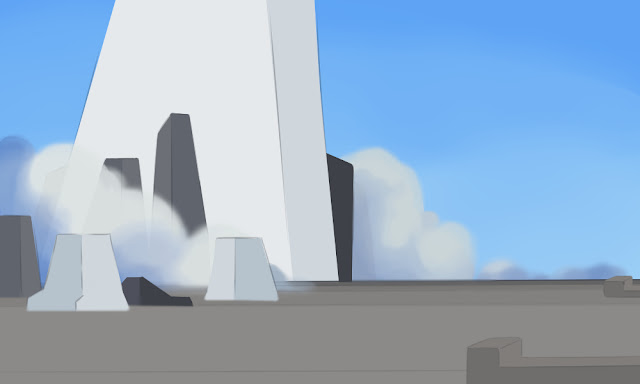
Pillar


Creating the stages
Stage 01
Step 1) Canvas Size
The width and height will be 1000 X 600

Step 2) Importing the sketch version from the planning stage

Step 3) Refining the stage

Tools used:

Pen tool will be used for the base colour.

 Brush tool is used to create soft stroke colours as well as to blend the colours.

The finished product.


The process of editing the other stages is the same as the one shown.


Creating the menu
Main menu
Step 1) Canvas Size

The width and height will be 1000 X 600

Step 2) Importing the sketch version from the planning stage


Step 3) Refining the stage

The tools used are similar to when creating the part of the stages

The finished product

The process of editing the other menu is the same as the one shown.

Settings


Creating the user interface

Video game icon

Step 1) Canvas Size

The width and height will be 1000 X 600

Step 2) Importing the sketch version from the planning stage

Step 3) Refining the video game icon


Final product

Stage 01

Stage 02

Stage 03


Stage 04

Stage 05


Popular posts from this blog

Concept drawings

  Main character This is how the playable character would look like. Sprites Those are the sprites for the main character, if a player does not do anything, only an idle sprite will be occurring, three separate sprites for running as well as for attacking. Enemies Each stage will have its own very enemies and different kinds of attacks Stages Story for each stage The stage will start at a village, Stage 01 is for a tutorial on how does the mechanic of the game works. Stage 02 will proceed to the forest, where the player encounters a bandit. Stage 03 will move to a hidden mountain whereby the leader of the bandit has been following the player. Stage 04 is the outside of the hidden mountain, where there is a mage to stop the character from going any further. Finally, Stage 05 is where the player will fight a boss that is called 'guardian', if the player succeeds against the boss, the pillar will give the character an additional power to use. User interface Main menu This is the m...

Ideas for in-game graphics, and concept art graphics

  Mind map Moodboard Inspiration Concept Art Synopsis With all that provided, the idea of the video game will use adventure as its genre. The moodboard is to give a picture of how does the playable character (main character) would look like as well as using a cel-shading art style that is inspired by a video game that is called 'Ghost Trick Phantom Detective'. For every stage, it will follow the concept art as shown.

Art Style used for Digital Graphics Computer Games

  Photorealism: Photorealism in video games implies that the character and scenery are thought to imitate real life in visuals as accurately as possible. Most photorealistic video games use a gritty aesthetic of which the style is being used in numerous war-related video games, for instance, the Call of Duty franchise. Given that the game shares the same goal that resembles real life as closely as possible. Cel Shading: Cel shading is a style of rendering the 3D computer graphics look three dimensional by creating flat colours on top of the base colour, making the object look three dimensional while keeping the effect of looking 2D. The legend of Zelda: The Wind Waker is probably one of the most well-known examples of its series using cel-shading technique, and it did so in an outstanding way. Despite the video game was released in early 2000, it does not appear to have aged as compared to other titles by reason of their distinctive art style. Exaggeration: An exaggeration is the...